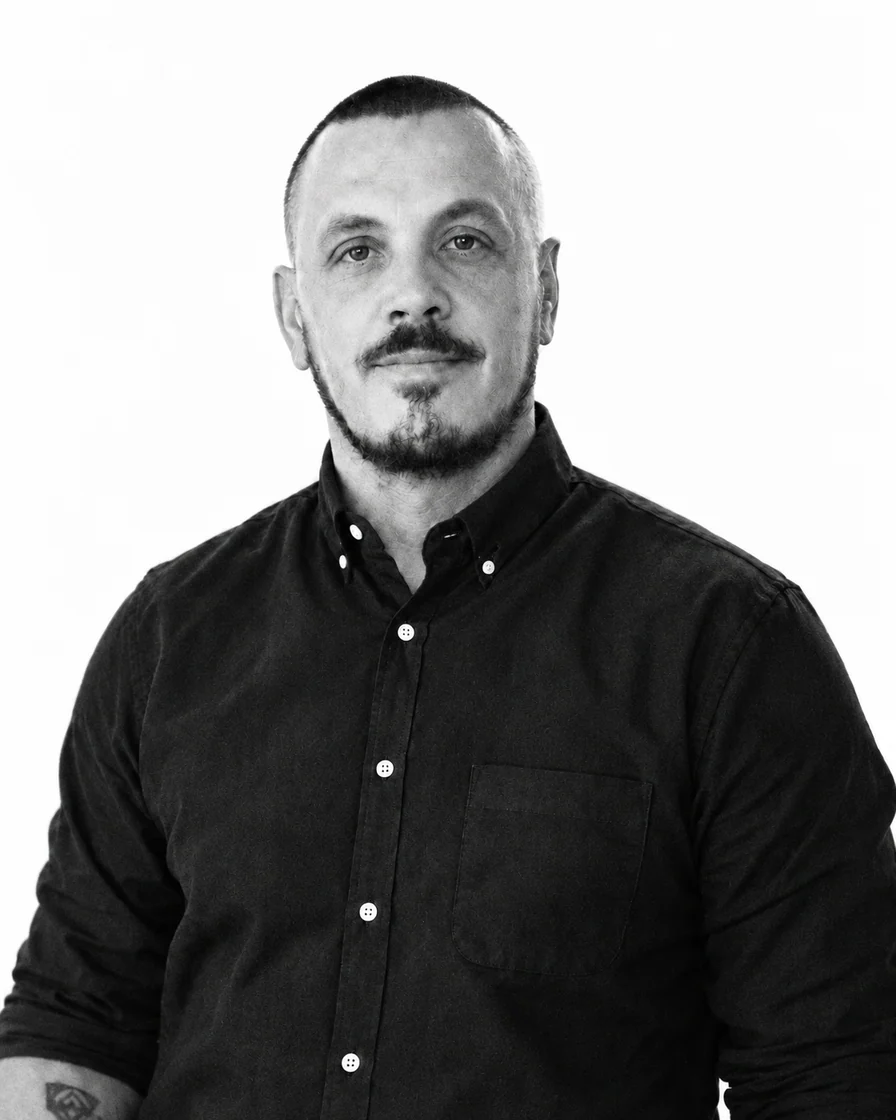
Fremtidens Tegnestue is architect Thais Espersen and AI and systems developer Mikkel Freltoft Krogsholm. We combine experience of buildings, places and people with digital tools and artificial intelligence (AI). With architecture studios, municipalities and foundations, we gather information, explore possibilities and develop tools for specific tasks.
Thais works with existing buildings, materials and everyday life. He explores how a place can be used and changed, and assesses proposals in relation to the building and its users. In a collaboration, he defines the architectural task and identifies what needs a site visit or assessment by other professionals.
Background and experience
Aarhus and the Bartlett
He studied at Aarhus School of Architecture and the Bartlett School of Architecture, UCL, where he completed his Master of Architecture in 2012.
Architecture in London
At CRAB Studio, he worked with Sir Peter Cook and Gavin Robotham. He later worked on the Kew House project.
Collective practice
He co-founded the architecture collective GI/IGA and has worked on competitions, exhibitions and exploratory architecture through SPLINT.
Danish practice
He worked as an architect at Tegnestuen Vandkunsten from 2015 to 2026. In June 2026, he moved on to build Fremtidens Tegnestue.
AI and systems developer
Mikkel Freltoft Krogsholm
Mikkel builds digital tools and connects data and programs. He turns the task into a solution that can, for example, find information, bring it together or prepare a first draft. He develops and tests the tool with you so that your professional task shapes how it works.
Background and experience
Political science
Mikkel has a master’s degree in political science from Aarhus University. His work has given him a practical understanding of systems, decisions and how rules affect organisations.
Data and systems
For more than a decade, he has worked with data analysis, forecasting, connecting software systems, web apps and automation, including at Teradata.
AI in practice
Through Brokk and Sindre, he builds AI and data solutions for organisations including Miinto, GoMore and BL, the Danish Federation of Non-Profit Housing Providers.
Author and speaker
He wrote Superpowers: How AI Can Change Your Life and speaks about the ways technology affects people.
We bring experience from architectural practice and developing digital solutions to Fremtidens Tegnestue. Our Cases page shows the prototypes we have built and what we are working on next. Each example explains what exists now and what requires development.
We define the task. You tell us what you want to investigate or make easier, and what material you have. Together, we choose one clearly defined task and establish who will use the result.
We agree what you receive. This could be an overview with sources, a first draft or a prototype of a digital tool. Before starting, we agree the result, price, your contribution and how to test the solution.
We develop and test. Thais and Mikkel work together on the architectural and technical parts of the task. You contribute knowledge of your practice. We review the result with you and agree what you can use and what needs adjusting.
We distinguish information from sources, our own assessments and what still needs investigation. AI helps prepare the work. The responsible architect or professional assesses the consequences; we agree which assessments we and your advisers will undertake. Confidential material is kept separate from other clients’ information.
Email or call Thais.
Briefly describe what you want to investigate, develop or make easier, and who will use the result. Thais is your first contact and involves Mikkel according to the task. You do not need to know about AI or have a finished plan. The conversation starts with your needs.
Please leave confidential documents out of your first email. We will agree a suitable way to share material.
Privacy policy
Read about personal data and analytics
Data controller
Fremtidens Tegnestue ApS CVR 46721721
Data collected
When you contact us by email, we process your name, email address and the content of your message. This information is used solely to respond to your enquiry.
Storage and security
Your data is stored securely and is not shared with third parties without your consent.
Home and project information
If you send an address, photographs, drawings, descriptions of your home or information about a studio workflow, we use that material to understand the enquiry and prepare a relevant answer. We only ask for material that is useful for the dialogue, and we do not treat it as public website content.
Public data sources
In some home and building enquiries, we may compare your message with public information such as Danish building register data, local plans, energy labels or municipal documents. These sources are used as preparation and must be interpreted in the specific case.
Retention
We keep enquiries only as long as needed to answer you, follow up on an agreement or document the dialogue you started. You may ask for access, correction or deletion unless other legal obligations require us to keep the information.
Processors and security
We use ordinary digital tools for email, hosting, operations and document handling. When a supplier processes personal data on our behalf, that processing must be governed by an agreement and protected by appropriate technical and organisational measures. We do not publish private enquiries, client material or project information on the website without agreement.
Optional usage analytics
Only if you choose “Allow analytics” do we load our self-hosted Umami installation to measure visits and fixed interaction categories. We do not send your email, address, dialogue text or raw search terms to Umami. A random ID may connect a visit to a later enquiry so we can understand which pages lead to relevant enquiries. Your choice and ID are stored locally in your browser for no more than 180 days. You can change the choice through “Analytics choice” at the bottom of the page. Analytics data is deleted from the active analytics system after no more than 180 days. Encrypted operational backups may be retained for up to six months and are used only for disaster recovery, not analytics.
Consent and dialogue
When you write to us, you allow us to respond to that specific enquiry. You can ask us to stop the dialogue or delete material you have sent if we no longer have a legitimate reason to keep it.
Your rights
You have the right to access, correct or delete your personal data at any time. Contact us at thais@fremtidenstegnestue.dk .